In Antiquity, to do science was to do philosophy
Important figures in Antiquity:
- Pythagoreans (6th to 5th century BCE)
- Plato (429 - 347 BCE)
- Aristotle (384 - 322 BCE)
- Eudoxus and Calippus (4th century BCE)
- Ptolemy (c. 100 - 170 CE)
cosmos = world order The All = universe
Antiquity
Hesiod = epic Greek poet (alongside Homer)
- Works = Works and Days (agriculture and calendar) and Theogony (account of the origins of the gods)
- The Greek alphabet was adapted around 800 BCE adapted from Phoenician and around 750 - 650 BCE, the epic poems were written down
- In Greek literature, there was an aspect of plurality when it came to their stories (there was no specific canon)
- Hesiod’s theology was also a cosmogony
cosmogony = account of the origin of the cosmos cosmology = account of the structure of the cosmos In Antiquity, the cosmos = “the world order” as they believed the universe was finite and so they focused on how it came to be and then what it is was made of
According to Hesiod’s Theology:
- consists of three layers (Heaven, Earth, and Tartarus/Underworld)
- there is a symmetry between the three layers where the distance between the layers is the same (a bronze anvil would fall for 9 days from one layer and hit the next layer on the 10th)
Milesian Philosophers (6th century BCE)
- Thales, Anaximander, Anaximenes of Miletus
- They worked on developing theories for the first principles / first elements
| Philosopher | First principle | Cosmology |
|---|---|---|
| Thales | Water | Earth floats on water |
| Anaximander | Aperion (Boundless / undefined) | Earth is in a state of equilibrium within the Boundless |
| Anaximenes | Air | Earth floats on air |
Pythagoreans (5th - 6th century)
- cult-like that followed the teachings of Pythagoras
- first principle = mathematical in nature (numbers and the ratio between numbers)
- found that ratios of numbers could describe harmonics and that if numbers could be applied to musical intervals, it might well be true of other things1
- octave 2:1
- fifth 3:2
- fourth 4:3
- believed that the heavens is a “musical scale and number” and that the movement of heavenly bodies give rise to concordant though inaudible sounds that we cannot hear because we’ve been used to them since birth2
- Another theory by Philolaus (late 5th century Pythagorean) =
- Hestia (central fire) is a separate body (invisible because we never face it), circling around Hestia is the counter-earth (invisible body that could account for eclipses maybe), then the earth, then the moon, sun, and the five visible planets with the naked eye, all circling Hestia
- this gives 10 circular bodies
Fourth century Astronomy
Saving the phenomena was an ancient philosophical and scientific goal to develop theories that could give an account of the apparent appearances of the heavens (sun, moon, planets and stars) by means of uniform circular motion
Main phenomena:
- all heavenly bodies circle the earth from east to west in about 24 hours (due to the earth’s daily rotation)
- different constellations are seen from a given point during different seasons of the year
- all heavenly bodies moves west to east through the band of the zodiac (due to the earth circling the sun)
- the planets and moon do not deviate by more than 8 degrees from the ecliptic
- the planets have their own time period to complete a single revolution through the zodiac
- retrograde motion of planets = appear to move backwards (east to west) for a moment before continuing their original path
- changing speed of the planets, sun, moon
Plato did not put emphasis on studying astronomy but he did see the heavens as the best part of the universe.
Plato gives his account of the heavens in the Myth of Er.
- see pg. 82 of Lloyd
“the whole heaven and earth, a straight beam of light, like a column, very closely resembling a rainbow, but brighter and more pure. They reached the beam after traveling another day’s journey. And there, in the middle of the light, they saw stretching from the heavens the ends of its bonds-for this light is what binds the heavens, like the cables underneath a trireme, thus holding the entire revolving thing together. From those ends hangs the spindle of Necessity, by means of which all the revolving things are turned.” (Plato, Republic)
- the rainbow column = axis of the universe
“That of the largest was spangled; that of the seventh was brightest; that of the eighth took its color from the seventh’s shining on it; that of the second and fifth were very similar to one another, being yellower than the rest; the third was the whitest in color; the fourth was reddish; and the sixth was second in whiteness.” (Plato, Republic)
- eight spheres (whorls) nested in one another = sun, moon, five planets, fixed stars
- outermost whorl = fixed stars
- Saturn = yellow
- Jupiter = whitest in color
- mars = reddish
- mercury = yellow
- Venus = white
- sun = brightest
- innermost whorl = moon = reflects the light of the sun
Geometric models
Eudoxus
- younger peer to Plato
- wrote a text: On speeds
- made the first geometrical model of the heavens = poles of spheres attached to one another to give the apparent motion of the cosmic bodies
“Eudoxus supposed that the motion of the sun or of the moon involves, in either case, three spheres, of which the first is the sphere of the fixed stars, and the second moves in the circle which runs along the middle of the zodiac, and the third in the circle which is inclined across the breadth of the zodiac; but the circle in which the moon moves is inclined at a greater angle than that in which the sun moves. And the motion of the planets involves, in each case, four spheres, and of these also the first and second are the same as the first two mentioned above (for the sphere of the fixed stars is that which moves all the other spheres, and that which is placed beneath this and has its movement in the circle which bisects the zodiac is common to all), but the poles of the third sphere of each planet are in the circle which bisects the zodiac, and the motion of the fourth sphere is in the circle which is inclined at an angle to the equator of the third sphere; and the poles of the third spheres are different for the other planets, but those of Venus and Mercury are the same.” (Aristotle, Metaphysics )
- outmost sphere = daily rotation (east to west, 23 hrs. 56 mins)
- the daily rotation is less than four minutes because the sun travels four minutes along the ecliptic in one day
- sphere for motion along the ecliptic (west to east)
- Eudoxus doesn’t equate the sun to the ecliptic, but believes that sun moves above and below the ecliptic like the other planets
- sidereal periods: sun = 1 year, moon = 27 days, Jupiter = 12 years, Saturn = 7 1/2 years
- pole of the second is perpendicular to the pole of the third sphere
- Eudoxus doesn’t equate the sun to the ecliptic, but believes that sun moves above and below the ecliptic like the other planets
- sphere for motion in latitude, north and south of the ecliptic
- the first three spheres are need for the sun and moon
- innermost sphere combined with the motion of the third brings about retrograde motion
- this gives the planet’s motion in a hippopede shape ()
Problems with Euodoxus’ model
- each hippopede always produced the same curve and so did could not accurately account mercury and venus’ retrograde motion
- failed to account for the inequality of the seasons
- failed to account for the change in apparent brightness and size
Calippus
- measured the length of the seasons
- spring: 94 days - vernal equinox to summer solstice
- summer: 92 days - summer solstice to autumnal equinox
- fall: 88 days - autumnal equinox to winter solstice
- winter: 90 days - winter solstice to vernal equinox
“Calippus made the position of the spheres the same as Eudoxus did, but while he assigned the same number as Eudoxus did to Jupiter and to Saturn, he thought two more spheres should be added to the sun and two to the moon, if we were to explain the phenomena, and one more to each of the other planets.” (Aristotle, Metaphysics )
Aristotle
- believed that there would be friction between the spheres and the motion of the spheres would affect one another
- e.g. for Saturn’s four spheres, there needs to be three additional counter-acting spheres to reset the motion for Jupiter.
- You would not need to counter act the daily rotation sphere (outermost sphere)
“But it is necessary, if all the spheres combined are to explain the phenomena that for each of the planets there should be other spheres (one fewer than those hitherto assigned) which counteract those already mentioned and bring back to the same position the first sphere of the star which in each case is situated below the star in question; for only thus can all the forces at work produce the motion of the planets … and of these only those by which the lowest-situated planet is moved need not be counteracted … if one were not to add to the moon and to the sun the movements we mentioned, all the spheres will be forty-nine in number.”
| # of spheres | Eudoxus | Calippus | counter-acting | combined | counter-acring |
|---|---|---|---|---|---|
| Moon | 3 | 5 | 0 | 3 | 0 |
| Sun | 3 | 5 | 4 | 3 | 2 |
| Mercury | 4 | 5 | 4 | 5 | 4 |
| Venus | 4 | 5 | 4 | 5 | 4 |
| Mars | 4 | 5 | 4 | 5 | 4 |
| Jupiter | 4 | 4 | 3 | 4 | 3 |
| Saturn | 4 | 4 | 3 | 4 | 3 |
| Total | 26 | 33 | 22 |
- Calippus + counter-acting spheres = 55
- combined model + counter-acting spheres = 49
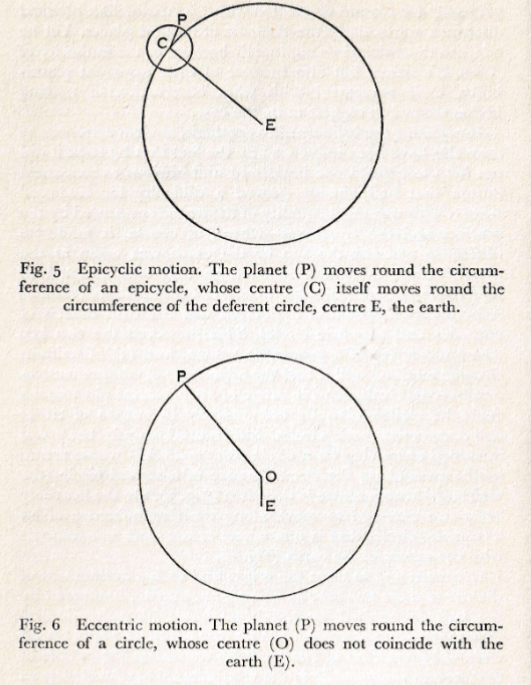
Epicycle model
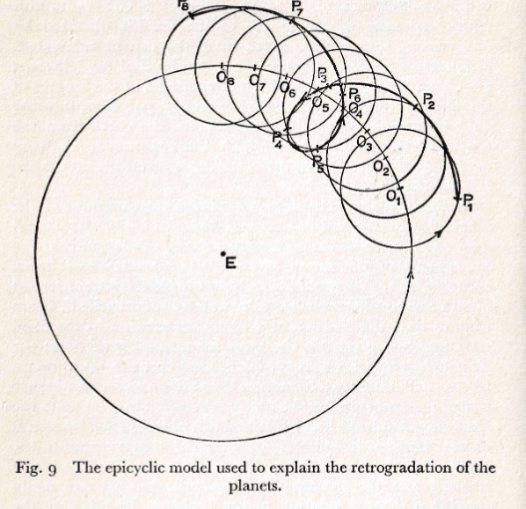
- accounts for apparent change of brightness and change in retrograde shape
Hellenistic period
This period begins with the death of Alexander the Great (323 BCE) and ended in the 1st century BCE when Greece was annexed to Rome
Heraclitus of Pontus (387 - 312 BCE)
- first to propose that the earth rotates west to east
Aristarchus of Samos (c. 310 - c. 230 BCE)
- first to propose that the earth revolves around the sun
- this hypothesis did not catch on because he did not propose a complete system and because observations go against this hypothesis
- cannot feel the rotation of the earth
- there was no concept of inertia
- there is a lack of stellar parallax = stars should appear to move closer or farther away from each other if the earth is rotating
- it did not solve the prevailing problems of the season, etc.
Hipparchus (190 - 120 BCE)
- made observations of the night sky
- created the first star map
- evidence of this was seen on a palamset
Apollonius of Perga (c. 240 - 190 BCE)
-
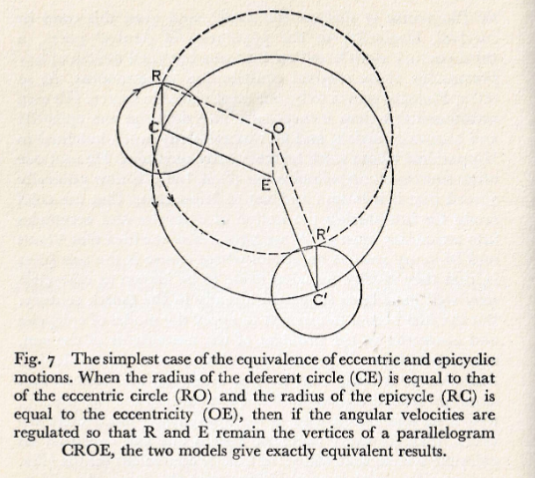
first proposed the epicyclic and eccentric model that Ptolemy later adapted
-
the epicyclic and eccentric models are kinematically equivalent
-
these models could account for the apparent changes in size and brightness. Combining the two models could account for the changes in retrograde shape
-
the inequalities of the seasons can be explained by the eccentric hypothesis
-
it can also account for the fact that the sun and moon do not have retrograde motion, while the planets do
- for the sun and moon, the epicycle rotates in the opposite direction to the deferent, while the planets’ epicycle rotates in the same direction to the deferent