The Copernican Revolution refers to the shift from a geocentric to a heliocentric model of the cosmos, spanning roughly from Ptolemy (2nd century BCE) to Newton. The transition required dismantling Aristotelian physics and rethinking the relationship between mathematics, observation and physical truth.
why-heliocentrism-lacked-proof-until-Newton
Objections to a heliocentric model
- ancient Greeks believed that earth is noble to occupy the center of the heavens
- Aristotelian argument from natural movements = heavy objects naturally travel towards the center of the earth and so the center of the earth may be presumed to coincide with the center of the universe
- If the earth was to rotate on its axis every 24 hours, it would need to do so at great speeds having a sensible effect on the movement of objects through air. See Ptolemy’s argument against a moving earth
- absence of stellar parallax = if the earth moves around the sun, there should be some variation in the relative positions of the stars observed from different points in the earth’s orbit
- the inequality of the seasons remained a problem for both geocentric and heliocentric models
Ptolemy (100 - 170 CE)
Ptolemy’s geocentric model, published in the Almagest (Mathematical Sytaxis), was the authoritative account of planetary motion for over 1300 years.
Ptolemy’s philosophy of knowledge
He placed mathematics at the top of theoretical philosophy (consisting of philosophy, theology, mathematics), arguing it alone produces certain knowledge:
From all this we concluded: that the first two divisions of theoretical philosophy should rather be called guesswork than knowledge, theology because of its completely invisible and ungraspable nature, physics because of the unstable and unclear nature of matter; hence there is no hope that philosophers will ever be agreed about them; and that only mathematics can provide sure and unshakeable knowledge to its devotees, provided one approaches it rigorously. (Almagest 1.1, p. 36)
Analysis = strong epistemic argument resulting in the mathematization of science. It helps justify why a mathematical model should be preferred over a purely physical speculation
Following Aristotle, Ptolemy argues that there are five elements (resting on top of one another) each with a natural motion: earth and water move downward, air and fire upward, and ether moves in perfect circles.
Ptolemaic model
The model combined two devices to account for observed planetary motion proposed by Aristarchus of Samos:
- eccentric model = the earth is offset from the center of a planet’s circular orbit
- provides account for the inequality of seasons
- epicyclic model = planet moves on small circles (epicycle) whose centers travel along a larger circle (deferent)
- provides account for retrograde motion
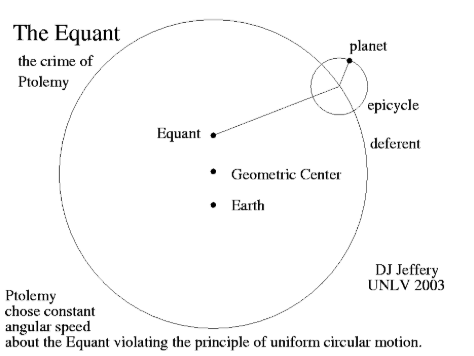
Ptolemy also introduced the equant = a point placed opposite the earth relative to the orbit’s center.
- It was a core belief of the time that planetary orbits had to be perfectly circular and moving at a constant speed. However, observations showed that planets appeared to speed up and slow down depending on where they were in the
- From the equant’s perspective, the planet moved at a constant angular speed, even though it traveled at varying physical speeds along its actual path.
Ptolemy’s argument against a moving earth
Ptolemy explicitly considered and argued against the hypothesis of Heraclitus and Aristarchus (see Hellenistic astronomy). He conceded that a rotating earth would produce the same apparent celestial motions as his model, but argued that it would make terrestrial phenomena impossible to explain:
His claims:
- in order to make one revolution in 24 hours it would have to rotate at incredible speeds
- an object thrown upwards would appear to drift westward if the earth rotated eastward beneath it
- even if the air moved with the earth, thrown objects would still appear to fall beneath it
- if objects were fused with the air, they would appear motionless
Nevertheless, they would have to admit that the revolving motion of the earth must be the most violent of all motions associate with it, seeing that it takes one revolution in such a short time; the result would be that all objects not actually standing on the earth would appear to have the same motion, opposite to that of the earth; neither clouds nor other flying or thrown objects would ever be seen moving towards the cast, since the earth’s motion towards the east would always outrun and overtake them, so that all other objects would seem to move in the direction of the west and the rear. But if they said that the air is carried around in the same direction and with the same speed as the earth, the compounded objects in the air would none the less always seem to be left behind by the motion of both [earth and air]; or if those objects appear to have any motion either in advance or rearwards: they would always appear still, neither wandering about nor changing position, whether they were flying or thrown objects. Yet we quite plainly see that they do undergo all these kinds of motion, in such a way that they are not even slowed down or speeded up at all by any motion of the earth. (Section 1.7, p. 45)
Critical Assessment: Ptolemy’s argument is physically reasonable within Aristotelian physics, which lacks the concept of inertia. He cannot conceive that an object thrown upward would retain the horizontal motion of the rotating earth. His argument is therefore not wrong it is a correct deduction from a false premise (Aristotelian physics). It would not be fully answered until Galileo developed the principle of inertia, and Newton formalized it.
Copernicus (1473 - 1543)
Copernicus worked in direct conversation with Ptolemy (1300 years later) and was also influenced by Islamic scholars. He began On the Revolutions of the Heavenly Bodies in 1514; it was published in 1543, the year of his death, overseen by the Lutheran clergyman Osiander. Copernicus had suffered a stroke in 1542 and did not live to see its reception
Motivation
In his letter to the pope, Copernicus justified the heliocentric proposal by
Appealing to ancient precedent = He cited pythagorean and ancient philosophers who had proposed similar ideas against popular belief, placing himself within the esteemed tradition of offering a model of the cosmos, in order to give more credibility to his idea and to not seem as absurd.
And first I found in Cicero that Nicetus [Pythagorean philosopher] had supposed that the Earth moved. After that I dis-covered in Plutarch [Platonic philosopher] also that certain others held the same opinion, and I have decided to quote his words here, so that they are generally accessible:
‘Some say that the Earth is at rest, but Philolaos the Pythagorean says that it is carried in a circle round the heavenly fire, slantwise, in the same way as the Sun and Moon. Heraclides of Pontus and Ecphantus the Pythagorean give the Earth motion, not indeed translatory, but like a wheel on its axis, from west to east, about its own center.’
I therefore took this opportunity and also began to consider the possibility that the Earth moved. Although it seemed an absurd opinion, nevertheless because I knew that others before me had been granted the liberty of imagining whatever circles they wished to represent the phenomena of the stars, I thought that I likewise would readily be allowed to test whether, by assuming some motion of the Earth’s, more dependable representations than theirs could be found for the revolutions of the heavenly spheres.
He also criticized internal consistencies within the geocentric model that it failed to produce a coherent, unified account of the heavens
For first, the mathematicians are so uncertain of the motion of the Sun and Moon [in the geocentric model] that they cannot represent or even be consistent with the constant length of the seasonal year. Secondly, in establishing the motions both of the Sun and Moon and of the other five wandering stars they do not use the same principles or assumptions, or explanations of their apparent revolutions and motions.
objections to the Ptolemaic model
- calendar problem = The Ptolemaic year was 365.25 days, which was adapted by the Julian calendar. It added a leap day every four years which caused The Julian calendar becoming 10 days out of sync with the natural year by the 16th century
- the Gregorian calendar reform of 1582 corrected this after Copernicus’ death
- Equant violation = Ptolemy’s equant allowed planets to sweep equal angles from a non-central point. Copernicus held that true uniform circular motion must be equal angles from the geometric center. He regarded Ptolemy’s equant as smuggling in non-uniform motion under a misleading definition.
- Lack of unity = Each planet had its own separate system of equant, epicycles and eccentrics. Copernicus compared this to a monster assembled from different bodies, not an integrated cosmos
Assessment of the objections = The calendar and the unity argument are strong practical arguments but are not strict logical proofs that the earth moves. The calendar problem was corrected without adopting a heliocentric model, and despite his objections of too many moving parts, Copernicus still used many epicycles and eccentrics. The equant objection rests on a narrower definition of uniform circular motion than Ptolemy’s making it a definitional argument rather than a physical one.
Copernicus’ model still has epicycles and eccentrics, but he eliminates equants. It also solves the problem of figuring out whether mercury and venus is below or above the sun, as the sun is now at the center.
Features of Copernicus model
- the universe and the earth is spherical
- the earth rotates daily on its axis and orbits the sun annually
- the motion of the heavenly bodies is uniform, circular, and perpetual, or compounded of circular motions
- eliminate equants
- placed mercury and venus interior to the earth’s orbit, naturally explaining why they are always observed near the sun
Copernicus’ argument for a moving earth
Copernicus argued that since the earth is spherical, it should follow the natural motion of spherical bodies, which is circular:
Surely Aristotle’s division of simple motion into three types, away from the middle, towards the middle, and round the middle, will be regarded merely as an intellectual division; just as we distinguish between a line, a point and a surface, although one cannot exist without the other, and none of them without a body … I also add that it would seem rather absurd to ascribe motion to that which contains and locates, and not rather to that which is contained and located, that is the Earth. Lastly, since it is evident that the wandering stars are sometimes nearer, sometimes further from the Earth, this also will be an example of motion of a single body which is both round the middle, by which they mean the centre, away from the middle, and towards it… . You see then that from all these arguments the mobility of the Earth is more probable than its immobility, especially in the daily revolution, as that is particularly fitting for the Earth.(p. 45)
Assessment = This argument is notably weak. He argues from probability and aesthetic reasoning (“more fitting”) rather than physics. His biggest problem is that he has no replacement physics. Aristotelian physics explained why objects fall toward the center of the cosmos, but if earth is no longer the center, then why do objects fall towards the earth? Copernicus has no apparent answer to this. He proposes motion but has no dynamics to support it. That would require Newton. Also, if the earth moves because it follows the natural motion of spherical bodies then there is an inconsistency as the cosmos do not move spherically.
Reception of the Copernican Model
Osiander’s preface in Copernicus work
Osiander’s unauthorized preface in Copernicus’ work presented the heliocentric model as a mere calculating tool =
For it is proper for an astronomer to establish a record of the motions of the heavens with diligent and skillful observations, and then to think out and construct laws for them, or rather hypotheses, whatever their nature may be, since the true laws cannot be reached by the use of reason; and from those assumptions the motions can be correctly calculated, both for the future and for the past… . Nor is it necessary that these hypotheses should be true, nor indeed even probable, but it is sufficient if they merely produce calculations which agree with the observations… but neither will grasp or convey anything certain, unless it has been divinely revealed to him. Let us therefore allow these new hypotheses also to become known beside the older, which are no more probable
Osiander’s view is based on instrumentalism that scientific theories do not need to be true, it just needs to give correct calculations and predictions.
The motive for this preface could be to lighten the theological blow to the reader that Copernicus model should not be take as true, and should just be seen along with the Ptolemaic model. However, tis is not Copernicus’ own view, as he believed he was describing the actual structure of the cosmos
Transitional figures
Tycho Brahe (1546 - 1601)
- observed the 1572 supernova and 1577 comet, neither should parallax which means that they were located beyond the moon
- showed that the heavens are mutable (they can change)
- created a cosmology that was a sort of compromise between the prevailing geocentric and heliocentric model proposed by Copernicus
- the earth remains at the center of the cosmos
- the moon, sun and the fixed stars revolve around the earth
- the five planets revolve around the sun
Johannes Kepler, an assistant to Tycho Brahe, inherited Tycho’s vast collection of observations
- in 1609, he published his Astronomia Nova, first mentioning the planets’ elliptical orbits, where the sun lies at one focus of the ellipse
- This was not influential until Newton appropriated it for his own laws of gravitation
Galileo
Galileo Galilei (1564 - 1642) appropriated the modern telescope and used it to provide direct observation for the heliocentric model.
- in 1609, Galileo learns about a new optical device in Holland called a spyglass, which was a tube connecting a convex lens with a concave lens magnifying 4 to 4 times
- Galileo improves the spyglass into the telescope that could magnify up to 100 times
Published the Sidereus Nuncius in 1610 (Starry Messenger or Message of the Stars) with his findings from the telescope, addressed to a broad audience
- Osiander claimed that the theory should only be used for predicition and calculation while Galileo aims his text on observation and phenemona that all should be interested in
Observations in the Sidereus Nuncius
Moon’s surface pg 31 at the time people thought the moon to be smooth and unblemished but Galileo observe craters and mountains on the surface, inferring their height from the behavior of sunlight reflected
- this does not directly support heliocentrism = the surface features of the moon would appear the same under either a geocentric or heliocentric model
- it is a powerful argument against Aristotle’s doctrine that celestial bodies are perfect, smooth, and made of a qualitatively different substance (ether) from the earth. It makes the earth-moon analogy more plausible.
The Multitude of Stars p. 47 Galileo observed hundreds of stars invisible to the naked eye - far more than previously catalogued.
- This expands the scale of the cosmos but does not directly support heliocentrism. It does undermine the intuition that human perception gives a complete picture of the heavens.
The Moons of Jupiter p. 55 Galileo observed four moons orbiting Jupiter (now called the Galilean moons). He explicitly used this to counter the objection that only the earth has satellites, showing that earth is not an exception in having a moon] by his observation of the four moons of Jupiter.
- Galileo clearly saw this as support for Copernicus. But it does not prove heliocentrism = Jupiter’s moons could be incorporated into a geocentric model by adding more shells around Jupiter such that they orbit in Jupiter’s vicinity in the same way that mercury and Venus orbit in the sun’s vicinity in the model
Galileo on Copernican model
- pg 28 states casually and subtly as a fact that the venus and mercury go around the sun
- pg 51 mentions copernican model directly and addresses the objection to the model that only the moon orbits the earth by his observation of the four moons of Jupiter, showing that earth is not an exception
The Galileo Affair
- The Church rivals against the Copernican model using Joshua 10:12-14 as their main evidence that referred to the sun moving
- in 1616, the Roman Catholic Church placed Copernicus’ On the Revolutions of the Heavenly Spheres on the index of Prohibited books
- Galileo was advised neither to teach nor defend the Copernican hypothesis
- in 162
- Galileo publishes the Dialogue concerning the two chief world systems which was an attempt to discuss both models in equal matter but clearly supports the heliocentric model